BLOG: One Woman's Quest for Legitimacy
I remember very clearly my father telling me about Harry Houdini and his skepticism of life after death. Apparently, Houdini told his wife to attend seances after he died; that if there really was another life after death, he would come and communicate with her. With his fame as an illusionist and ability to outwit people with his many feats of magic and deception, Dad always said that if there really was life after death, Houdini would have found it.
Not that I believe Dad was right . . . or that spiritualism was the answer.
This week, I have an intriguing blog post to share that should interest anyone intrigued by spirituality. I will not share my own beliefs here, but it does make for a fascinating conversation. Can the dead really communicate with the living during seances? Are these contrived events intended to decieve, bringing false hope to the living who have suffered a loss in their lives. Might these communications "from the dead" be something else entirely?
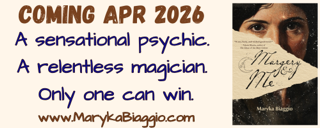
Maryka Biaggio's newest book explores the world of Margery Crandon, a spiritualist who led actual seances and was challenged in her work by Harry Houdini himself. Crandon's post-WWI humanity was composed of people who had lost faith and were filled with disillusionment and tragic loss. This was the world in which my own father and his family lived.
Maryka was a guest last year on Brook's Journal, and I hope she'll return again! Scroll down for her exploration into Crandon's story and READ ON, everyone!
Spiritualism After World War I and One Woman’s Quest for Legitimacy
Maryka Biaggio
In the years following World War I, spiritualism did not merely survive—it flourished. Séance rooms filled, mediums became celebrities, and even scientists and intellectuals were fascinated by the prospect of communing with the dead. To modern eyes, this interest in psychics might seem naïve or theatrical. But spiritualism’s postwar explosion was neither accidental nor irrational. It was a response to a world shattered by war and the great influenza epidemic.
The Great War killed on an unprecedented scale. Nearly every family in Europe and America lost someone—sons, brothers, lovers, husbands—often without a body to bury or a grave to visit. Death came suddenly, anonymously, and far from home. Traditional mourning rituals offered little comfort in the face of such large-scale loss.
Spiritualism offered something radically new: a continued relationship. The dead were not gone, it promised, only relocated. They could speak. They could reassure. They could tell their story. In a time when silence felt unbearable, spiritualism gave grief a voice.
Before the war, science, progress, and rationality were widely believed to be humanity’s salvation. The war destroyed that faith. Modern technology—machine guns, gas, and artillery—had not lifted humanity upward but dragged it into mechanized slaughter.
For many, the war exposed a spiritual vacuum. Churches often failed to explain the catastrophe in ways that felt meaningful. Spiritualism stepped into that void, offering a belief system that felt personal rather than institutional, experiential rather than doctrinal. You didn’t need a minister; you needed a table, a darkened room, and hope.

Contrary to popular myth, spiritualism was not embraced only by the gullible. Engineers, physicians, psychologists, and chemists attended séances. Some investigated skeptically; others emerged convinced. The language of spiritualism often borrowed heavily from science—“energy,” “vibrations,” “forces”—making belief feel modern rather than regressive.
This blending of scientific curiosity with metaphysical longing gave spiritualism credibility, at least temporarily. If science could invent radio waves—messages traveling invisibly through the air—why couldn’t spirits communicate with the living?
The postwar spiritualist movement also gave women an unusual form of authority. Mediumship offered public power at a time when women were still excluded from many professional and political spaces. Through trance and performance, women spoke—and men listened.
This unsettled the establishment. A woman claiming access to invisible realms challenged both scientific hierarchy and social norms. Figures like Margery Crandon, the subject of my novel Margery and Me, did not merely channel spirits; they exposed how fragile male authority could be when certainty itself was shaken.
Séances were not only acts of belief; they were acts of theater. In a traumatized society, performance mattered. The dim lights, the ritual, the suspense—all created a shared emotional experience. In a world fractured by loss, séances rebuilt intimacy, if only for an evening.
Belief, in this sense, was not about truth versus fraud. It was about need. People needed to feel that death had not won, that meaning still existed, that love endured beyond the grave.
Spiritualism’s popularity also guaranteed its enemies. Figures like Harry Houdini viewed the movement as dangerous, predatory, or delusional. Their crusades against mediums were fueled not only by reason but by grief, fear, and moral outrage. The public battles between believers and skeptics became proxy wars over how to live in a world where certainty had collapsed.
Into this controversy stepped the authoritative magazine Scientific American. In 1922, the magazine offered a cash prize to any medium who could demonstrate bona fide psychic phenomena. And that’s where the subject of my latest novel, Margery Crandon, comes in. Margery’s husband, a respected surgeon in Boston, entered Margery in the contest, and what ensued was a great battle between Margery and Harry Houdini, one of the members of the Scientific American prize committee. All the scientists on the committee thought Margery was a genuine psychic, but Houdini insisted she was a fraud. The story of her quest for the prize and Houdini’s attempts to undo her created a sensation in America and Europe.
So at the height of popularity for the spiritualism movement, Margery Crandon and Harry Houdini faced off in a battle of wits. And their contest proved an irresistible subject for this novelist!

Spiritualism’s postwar boom was not a strange detour in history—it was a human response to trauma. When the familiar frameworks of meaning fail, people look elsewhere. They always have. In this way, the séances of the 1920s are not so distant from modern obsessions with near-death experiences, paranormal investigations, or digital attempts to preserve the voices of the dead. The technology changes; the longing does not.

ALL ABOUT MARYKA
Maryka Biaggio is an award-winning novelist with a passion for history and the human spirit. She writes historical fiction inspired by real people—figures whose lives illuminate the complexities of their time. She loves the challenge of starting with actual historical figures and dramatizing their lives. She prides herself on carefully researching the period, place, and people to provide readers with an immersive experience.
Maryka served on the Board of the Historical Novel Society North America Conference from 2015 to 2025 and has mentored writers in the Association of Writers and Writing Programs’ Writer-to-Writer Mentorship program since 2020. An avid opera fan, she also enjoys gardening, art films, and, of course, great fiction. She lives in Portland, Oregon. Her novel Margery and Me, published by Regal House, has been hailed by distinguished author Valerie Martin as “a wry, lively, and wicked-good novel.”
CONNECT WITH MARYKE & BUY THE BOOK!

Click here for print, ebook, or
audiobook!
Comments