BLOG: Richard, Duke of York~ Who was he?
Hello, readers!
It is so hard to believe it's December with the Holidays all before us. It's a busy time, shopping, Christmas or Hanukkah-themed activities, as well as time spent with friends and family. I have been participating in some craft-fairs this year, selling my titles and I have been delighted in the number of sales I have made so far. This coming Saturday, I'll be at St. Mark's United Methodist Church in Daleville, Virginia from 9am-2pm, signing books. If you are in the area, stop by, check out the crafts and say hello. Books make excellent gifts!
Ever since the skeleton of Richard III was discovered in a parking lot in northern England, I have been fascinated with the history of the Wars of the Roses. This week, Wendy Johnson is sharing more about not just Richard III, but his father. The old adage, "like father, like son?" Well, for this father/son duo--both named Richard of York, there were startling similarities in their lives and even their deaths.
So get ready for a lively history lesson with Wendy, for she has shared some pretty fascinating details regarding the House of York.
And read ON, everybody!
Richard, Duke of York: Rightful Heir, Father of Kings and Alleged Traitor
By Wendy Johnson
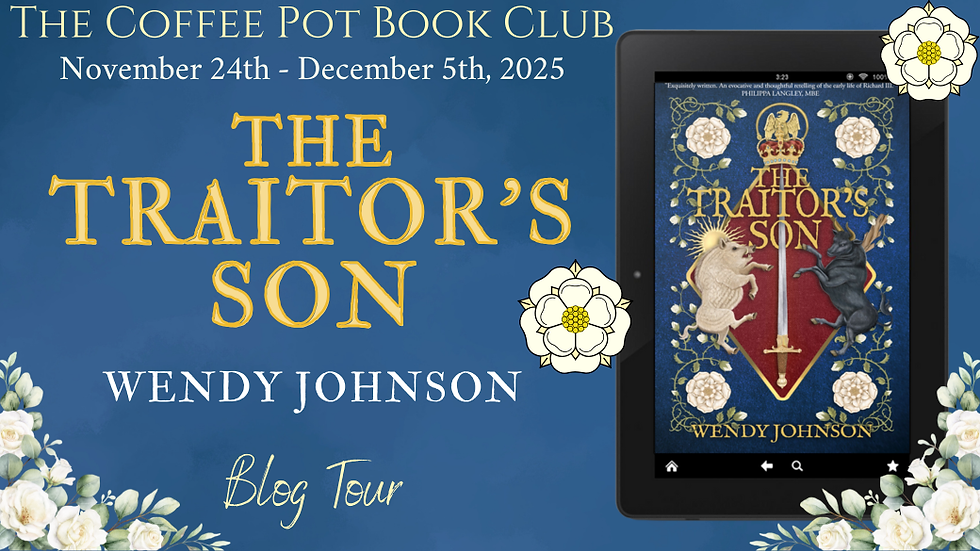
My debut novel ‘The Traitor’s Son’ is the first in a proposed trilogy charting the brief, and equally tragic, life of Richard Plantagenet—later to ascend the throne as King Richard III.
The title of the book refers to the fact that Richard was the youngest son of another Richard Plantagenet—Richard, 3rd Duke of York, King by Right, a man who was branded a traitor by his Lancastrian foes and slain at the battle of Wakefield in 1460.
So, who was Richard, duke of York—and why was he considered a traitor by his enemies? Well, the first question is easy to answer, the second depended upon whether one supported the House of Lancaster, or the House of York, during the turbulent period known to history as the Wars of the Roses.
This civil war began in May 1455 with the First Battle of St. Albans, but the circumstances which ignited the conflict go back a lot further. The two royal houses—York and Lancaster—were descended from the sons of Edward III. The Yorkists were descended from both the second and fourth sons, the Lancastrians from the third; both therefore had claims to the throne, but the Yorkist claim was the stronger. The usurpation of Henry Bolingbroke in 1399, meant that power lay with the Lancastrians, but by 1422, when Bolingbroke’s son, the warrior king, Henry V, died young and the crown fell to his nine-month-old son, Henry VI, chaos reigned.
As the child grew under the guidance of his uncles, it became clear that he was not cut from the same cloth as his father. Young Henry, although serious and devout, was not the right kind of man to rule a kingdom. His wife, however, was a different matter. Marguerite of Anjou was a strong and determined woman, whose influential favourites soon became unpopular with the nobility, and as Henry’s mental health began to fail, Marguerite, who could easily control the king, came to rely more and more on her favourites, and a division arose at the highest level.
Enter the king’s cousin, Richard, duke of York—a man whose claim to the throne was greater than Henry’s, and around whom a faction had begun to grow. When Henry’s sanity fell into question and a protector was required to rule in his stead, Richard of York became the man of the moment. But York’s relationship with Queen Marguerite had never been a good one. Despite holding the Lieutenancy of France, and later, the Lieutenancy of Ireland, Richard of York’s position in England was precarious, and he had at one time found himself consigned to the margins due to the hatred of the queen, and suffering what he claimed to be a whispering campaign against him. Marguerite certainly seems to have disliked York since the early 1450s and York had upon one occasion felt himself so threatened that he had demanded the removal of Edmund Beaufort, duke of Somerset—Marguerite’s intimate advisor. Somerset was briefly removed, but soon restored to favour, while York himself had been taken into temporary custody.
However, during Henry’s later incapacity and York’s appointment as Protector of the Realm, the duke’s prospects improved, as did those of the kingdom. York was successful in reversing the damage to the crown finances wrought by the incompetence of the queen’s favourites. He also sought to rule in full consultation with the royal council. A chronicler of the time claimed that York ‘governed the whole realm of England most nobly and in the best way.’ Things changed, however, when the king’s sanity returned, and York was removed from office; his old enemy, Somerset, at once re-established as one of Henry’s chief counsellors.
Having given birth to a new Lancastrian heir, Marguerite now began to resent York even further. In her eyes, the fact that he had a better claim to the throne than her husband led her to view York as a threat, even though York himself had made no move whatever to pursue his claim. A growing hostility meant that York had to take steps to defend himself and in May 1455, the forces of York and Lancaster clashed at St. Albans and the Wars of the Roses began.
In 1460, Parliament attempted to settle the matter by passing the Act of Accord, which stated that Henry could remain king until his death, whereupon the crown would pass to the rightful heir, Richard of York. Marguerite, unwilling to accept this, was eager to fight for the rights of her son, whilst York—King by Right—was branded a traitor, and as such, began to fear for his life. In December 1460, he rode north to deal with Marguerite’s military forces and was killed at Sandal Castle, at what has become known as the battle of Wakefield.
My novel ‘The Traitor’s Son’ begins in 1461, during the aftermath of this disastrous event, with young Richard Plantagenet (the future Richard III) distressed, grief-ridden, and as the son of a ‘traitor’, in fear of his life. So, did young Richard’s life resemble that of his father, and if so, how?
The similarities between father and son are striking. Apart from the obvious fact that they shared a Christian name, it was remarked upon during Richard’s lifetime that he physically resembled his father, the Duke of York. York and his son both grew up in the north of England; York, born at Conisbrough in Yorkshire, was raised by the northern-based Neville family, while Richard, although born in Northamptonshire, spent his youth in the Yorkshire fortresses—and under the care of his cousin—Richard Neville, earl of Warwick. Both York and his son were thrust into political situations which caused them to be appointed Protector (York in 1454 and again in 1455; Richard in 1483, following the death of his brother, Edward IV). Both men faced opposition and feared for their lives at the hands of a queen and her favourites (York menaced, as we have seen, by Marguerite of Anjou, and Richard suffering plots against his person at the hands of Elizabeth Woodville and her ambitious relatives).
Both father and son found themselves at the centre of constitutional crises (York, due to the mental breakdowns of Henry VI; Richard due to the disputed legitimacy of Edward IV’s heirs). York and his son, Richard, were both killed in battle by their enemies—accused of treason, reputations sullied by those who wished to malign them.
Both Richards sought to rid the kingdom of corruption, and those who sought to empower themselves at the expense of the realm. But ultimately, Richard duke of York and his son, the future Richard III, were figures against whom fate seemed to conspire. The sad distinction is that York had sired sons who subsequently avenged his death, while Richard III’s only legitimate son died as a child only a year before his own demise at the battle of Bosworth.
Had Richard himself lived longer than his thirty-two years, with a mature heir and successor, it is doubtful whether the tenuous claim of the Tudors would have be realised: the Plantagenet dynasty may well have continued, and the history of England turned out very differently.
ALL ABOUT THE BOOK
Caught between a king and a kingmaker, young Richard Plantagenet knows he’ll have to choose...
1461: Richard Duke of York, King by Right, has been branded a traitor and slain by his Lancastrian foes. For his eight-year-old son—Richard Plantagenet—England has become a dangerous place.
As the boy grapples with grief and uncertainty, his elder brother, Edward, defeats the enemy and claims the throne. Dazzled by his glorious sibling, young Richard soon discovers that imperfections lurk beneath his brother's majestic façade. Enter Richard Neville, Earl of Warwick—cousin, tutor, luminary—whose life has given him everything but that which he truly craves: a son. A filial bond forms between man and boy as they fill the void in each other’s lives. Yet, when treachery tears their world asunder, Richard faces an agonizing dilemma: pledge allegiance to Edward—his blood brother and anointed king—or to Warwick, the father figure who has shaped his life and affections.
Painfully trapped between duty and devotion, Richard faces a grim reality: whatever he decides will mean a fight to the death.
In "The Traitor’s Son", Wendy Johnson weaves a tapestry of loyalty, love, and sacrifice against the backdrop of England's turbulent history. Through the eyes of a young Richard III, readers are transported into a world where every choice is fraught with peril, and the bonds of kinship are tested to their limits.
Perfect for fans of Hilary Mantel, Annie Garthwaite and Sharon K. Penman.
Praise for The Traitor’s Son:
“Exquisitely written. An evocative and thoughtful retelling of the early life of Richard III.”
~ Philippa Langley, MBE
“Sometimes the perfect use of the written word takes my breath away. Not very often but this book is it. A wonderful story written so beautifully that I shall not forget it for a long time. Everything to my mind is perfect. The language, the story, the pacing. Just wonderful.”
~ Kindle Customer, 5* Amazon Review
“Wonderfully woven story of a young Richard III. Woven with a sure knowledge of the history and a realistic telling of a story about a young boy finding his way through tragedy and triumph, uncertainty and a legacy he cannot escape.Brilliant debut which promises more and more.”
~ Cris, 5* Amazon Review
“I loved this novel, it was beautifully written, extremely atmospheric, the characters’ personalities came through perfectly, can’t wait for the next instalment.”
~ Linda Hayward, 5* Amazon Review
“Really enjoyed this book. Holds the reader enthralled from the first paragraph to the last. The next volume can't be released soon enough.”
~ J.M. Henderson, 5* Amazon Review

ALL ABOUT WENDY
Wendy Johnson has a lifelong passion for medieval history, its people, and for bringing their incredible stories to life. Her specific areas of interest are the fifteenth century, the Wars of the Roses, and Richard III in particular. She enjoys narratives which immerse the reader in the past, and tries faithfully to recreate the later Middle Ages within in her own writing. She has contributed to a number of historical anthologies and was a runner up in the Woman and Home Short Story Competition 2008.
Wendy is also a founder member of Philippa Langley’s Looking for Richard Project, which located the king’s lost grave in 2012. She co-authored Finding Richard III: the Official Account of Research by the Retrieval and Reburial Project in 2014, and in 2019 received the Richard III Society’s Robert Hamblin Award.
THE TRAITOR’S SON, volume one in a Richard III trilogy, is Wendy’s debut novel and she is currently working on the sequel.
CONNECT WITH WENDY
BUY THE BOOK!!!

~This title is also available on KindleUnlimited~
Thank you so much for hosting Wendy Johnson today, with such an interesting post about Richard of York, linked to her fabulous new novel, The Traitor's Son. Enjoy your book signing event! Take care, Cathie xo The Coffee Pot Book Club